Commercial Battery Storage: Costs and Benefits for UK Businesses

Quick Answer
Commercial battery storage in the UK typically costs £140–£800 per kWh installed. Smaller systems cost more per kWh. Larger systems cost less. A 100kWh system often costs £20,000–£45,000.
Batteries cut costs by storing solar power, avoiding peak-time rates and lowering maximum demand. Most pay back in 4 to 10 years. Paired with solar, payback is often under 7 years.
Key Takeaways
- Pricing falls sharply as system size rises.
- The biggest savings come from solar self-use and peak shaving.
- Batteries can help add EV chargers or machinery without a grid upgrade.
- In England, onsite batteries are exempt from business rates until 31 March 2035.
- Base the business case on site savings, not grid service income.
Energy is one of the biggest costs for many UK businesses. Peak-time rates and capacity charges can push bills even higher.
Commercial battery storage gives you more control. It stores cheap or solar power and releases it when power is expensive.
This guide covers costs, benefits, tax rules and payback. It will help you decide if a battery suits your site.
What Is Commercial Battery Storage?
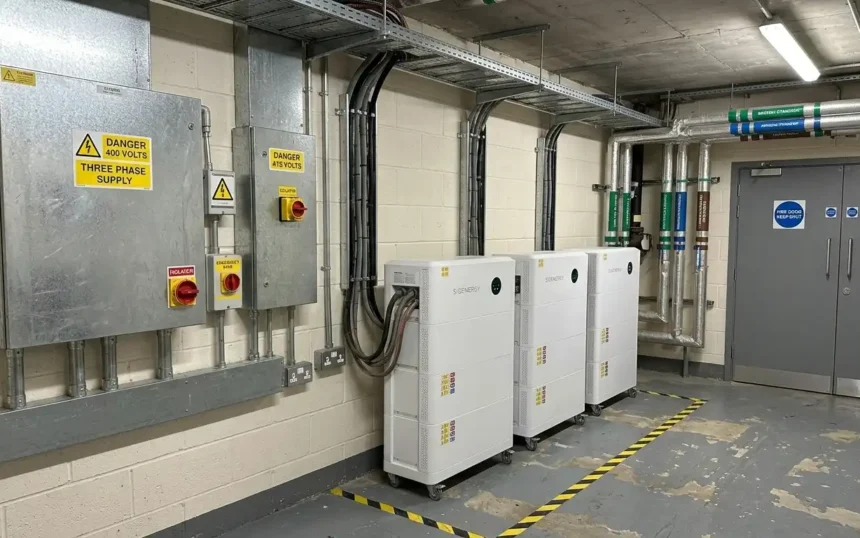
Commercial battery storage is a large battery system fitted at a business site. It stores electricity for use later.
It can charge from solar panels, the grid or both. Smart controls decide when to charge and discharge.
Systems range from about 30kWh for a small shop to several MWh for a factory. Larger systems often sit in an outdoor container.
How Much Does Commercial Battery Storage Cost in the UK?
Commercial batteries usually cost £140–£800 per kWh installed. The price per kWh drops as the system gets bigger.
| System size | Typical cost per kWh | Example total cost | Typical site |
|---|---|---|---|
| Up to 50kWh | £400–£800 | £20,000–£40,000 (50kWh) | Shops, offices, small farms |
| 100–500kWh | £200–£450 | £20,000–£45,000 (100kWh) | Warehouses, schools, hotels |
| 500kWh+ (containerised) | £140–£300 | £140,000–£300,000 (1MWh) | Factories, cold stores, large estates |
Indicative prices, excluding VAT and any grid connection upgrades. Every site needs its own quote.
What Affects the Price?
- Capacity (kWh) — how much energy it stores.
- Power (kW) — how fast it charges and discharges.
- Controls and software — smarter controls earn more savings.
- Location — indoor, outdoor or containerised.
- Grid connection — some sites need DNO upgrades or studies.
- Fire safety measures — separation, detection and ventilation.
How Does Battery Storage Save a Business Money?
A commercial battery saves money in five main ways.
1. Using More of Your Own Solar Power
Many sites export solar power at weekends or during quiet hours. A battery stores it for later.
In one published UK case, a 295kWp solar array with a 443kWh battery raised solar self-use from 45% to 81%.
2. Peak Shaving
Peak shaving cuts your site’s highest demand. Lower peaks can reduce capacity-related network charges.
The battery supplies power during short spikes, such as when machinery starts up.
3. Avoiding Peak-Time Rates
Many business tariffs charge more at peak times. Distribution charges are highest in the “red band”, often late afternoon and early evening.
A battery charges at cheaper times and runs your site through the red band.
4. Working Around Grid Limits
Want to add EV chargers or new machinery? Your grid supply may not be big enough.
A battery can top up supply at busy times. This may avoid or delay a costly grid upgrade.
5. Backup Power and Resilience
With the right design, a battery can keep key equipment running in a power cut. This suits cold storage, IT and security systems.
Can Commercial Batteries Earn Income From the Grid?
Yes, some can. Larger or aggregated systems may join flexibility and grid service markets.
But this income is less predictable than it once was. Frequency service income has fallen sharply since 2022.
Our advice: build your case on site savings first. Treat grid income as a bonus.
What Is the Payback Period for Commercial Battery Storage?
Most commercial batteries pay back in 4 to 10 years. With solar, payback is often under 7 years.
Payback is fastest for sites with:
- Large solar arrays that export a lot.
- High or spiky peak demand.
- Heavy use during peak-rate hours.
- Grid limits blocking expansion plans.
- Long operating hours, including evenings.
What Tax Reliefs Apply to Commercial Battery Storage?
- VAT: commercial installs are charged at 20%. VAT-registered businesses can usually reclaim it.
- Business rates: in England, onsite battery storage and renewable generation are exempt from 1 April 2022 to 31 March 2035.
- Capital allowances: batteries are usually treated as plant and machinery. They may qualify for the Annual Investment Allowance or full expensing.
We are electricians, not tax advisers. Always confirm reliefs with your accountant.
How Can a Business Fund Battery Storage?
There are four common routes:
- Outright purchase. Highest savings and full ownership.
- Asset finance or leasing. Spreads the cost over time.
- Power purchase agreement (PPA). A third party funds the system. You buy the power.
- Shared savings. A funder installs the system and shares the savings with you.
Which Businesses Benefit Most From Battery Storage?
- Manufacturers with heavy machinery and demand spikes.
- Cold stores and food producers that run around the clock.
- Warehouses and logistics sites with EV fleets.
- Farms with large roofs and solar arrays.
- Hotels and leisure sites with busy evenings.
- Schools and offices with big solar arrays and quiet weekends.
How Is Commercial Battery Storage Installed?
- Data review. We study your half-hourly energy data and bills.
- Feasibility and modelling. We size the battery in kW and kWh and model savings.
- Grid application. Most commercial batteries need G99 approval from your DNO. This can take weeks or months.
- Design and fire safety. We plan safe siting, separation and protection. Tell your insurer early.
- Installation. Smaller systems take days. Containerised systems take longer.
- Commissioning and controls. We test the system and set the charging strategy.
- Monitoring. You track savings and performance through an online platform.
All work must meet BS 7671 wiring rules. Our commercial electrical services team handles the full electrical side.
How Long Does Commercial Battery Storage Last?
Most modern commercial batteries use lithium iron phosphate (LFP). They usually last 10 to 15 years.
Warranties often run for about 10 years. Many include a cycle or energy throughput limit. Check this against how hard the battery will work.
Is Commercial Battery Storage Worth It?
For many UK businesses, yes. It is strongest for sites with solar, high peak demand or grid limits.
The key is good data. A battery sized from real half-hourly usage will outperform a guess every time.
Frequently Asked Questions
How much does commercial battery storage cost in the UK?
Most commercial batteries cost between £140 and £800 per kWh installed. Small systems cost more per kWh. Large containerised systems cost the least. A 100kWh system is often £20,000–£45,000.
What is the payback period for commercial battery storage?
Payback is typically 4 to 10 years. Sites with solar panels often see payback in under 7 years.
Is commercial battery storage worth it without solar panels?
It can be, for sites with high peak demand or costly peak-time rates. The battery charges when power is cheap and supports the site at peak times. Pairing it with solar usually improves the return.
Do businesses pay VAT on battery storage?
Yes. Commercial battery storage is normally charged at the standard 20% VAT rate. VAT-registered businesses can usually reclaim it. Confirm with your accountant.
Do batteries increase business rates?
Not in England for now. Onsite battery storage and renewable generation are exempt from business rates from 1 April 2022 to 31 March 2035.
How long does commercial battery storage last?
Most lithium iron phosphate (LFP) commercial batteries last 10 to 15 years. Warranties usually run for about 10 years, often with a cycle or energy throughput limit.
Talk to Us About Battery Storage for Your Business
Welton Renewables has delivered electrical and renewable projects since 2010. Our NICEIC-approved team designs commercial solar and storage around your real energy data.
We support businesses across Bedford, Dunstable, Hitchin, Leighton Buzzard and Bedfordshire.
Call 07500 867106 to request a free feasibility review. See our commercial solar installation and battery storage services.